Fast Company / Producing While Consuming Less for the Future of the World
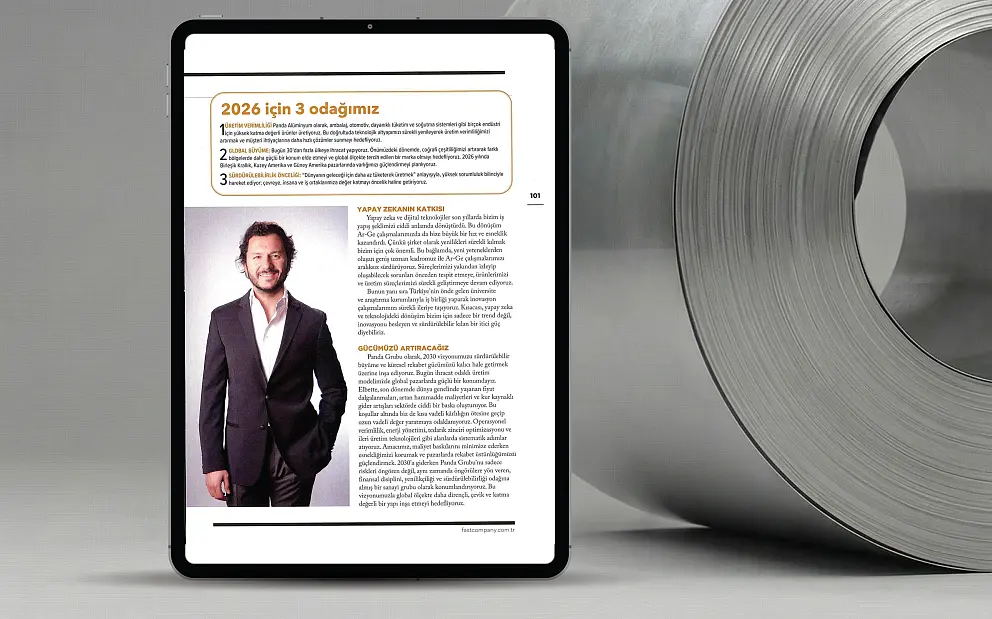
Hüseyin Seherli, Vice Chairman of the Board of Panda Aluminum, shared the vision of Panda Group, which is shaped around sustainability, innovation, and financial discipline. Emphasizing that they act with the principle of “producing more by consuming less for the future of the world,” Seherli stated that they aim to build a more resilient, agile, and value-added structure on a global scale.
Highlighting that the aluminum industry has undergone a significant transformation in recent years driven by sustainability, Seherli underlined that energy efficiency, increasing recycling rates, and reducing environmental impact are now among the top priorities. He noted that aluminum offers a major advantage for the circular economy, as it does not lose its properties when recycled and can be reused indefinitely. He added that the fact that approximately 75% of all aluminum ever produced is still in use today clearly demonstrates this potential.
How does Panda Aluminum make a difference?
Seherli stated that Panda Aluminum, operating under Panda Group since 2006, distinguishes itself by combining high-quality production with sustainability, innovation, and a forward-thinking perspective. He explained that in an increasingly competitive market, they focus on three key areas:
Sustainable production: Continuous improvement with a focus on energy efficiency and resource management
Digital transformation: Technological investments that enhance quality and operational efficiency
Customer commitment: Long-term partnerships and trust-based value creation
He also added that Panda Group’s diversified presence across aluminum, energy, food, mining, and venture capital creates strong synergy and enhances resilience against changing market conditions.
The era of low-carbon production
Seherli stated that they expect growth in the aluminum sector to continue both in Türkiye and globally as of 2026. According to international research, the global aluminum market is projected to reach 90 million tons by 2030. He emphasized that electrification, renewable energy, and sustainable packaging investments will be the key drivers of this growth.
In Türkiye, he highlighted that the transition to low-carbon production—driven by the Carbon Border Adjustment Mechanism—will become one of the most critical agenda items for the sector.
Three strategic priorities for 2026
Seherli summarized Panda Aluminum’s 2026 goals under three main pillars:
Production efficiency: While continuing to deliver high value-added products to industries such as packaging, automotive, durable goods, and cooling systems, we aim to enhance efficiency by strengthening our technological infrastructure.
Global expansion: We currently export to more than 30 countries. In the coming period, we plan to establish a stronger presence in new markets, particularly in the United Kingdom, North America, and South America.
Sustainability focus: We remain committed to sustainable growth by strengthening our production approach that creates value for the environment, people, and our business partners.
2030 vision: Sustainable growth and strong competitiveness
Seherli stated that Panda Group’s 2030 vision is built on sustainable growth and establishing lasting global competitiveness. He emphasized that with its export-oriented production model, the Group holds a strong position in international markets.
Noting that global price fluctuations, rising raw material costs, and exchange rate-driven expenses are creating pressure on the sector, Seherli said that they prioritize long-term value creation over short-term profitability.
He added that they aim to minimize cost pressures through investments in operational efficiency, energy management, supply chain optimization, and advanced manufacturing technologies. “As we move toward 2030, we position Panda Group not only as an industrial group that anticipates risks, but also as one that shapes those expectations,” he concluded.